CORE CONCEPTS

EMP Core Concepts

This is the public English glossary of EMP.It defines how EMP speaks about experience, meaning, possibility, repeated patterns, desire, cost, and choice space.This page explains public concepts only. It does not disclose internal weights, mapping matrices, risk thresholds, testing logic, or private case data.
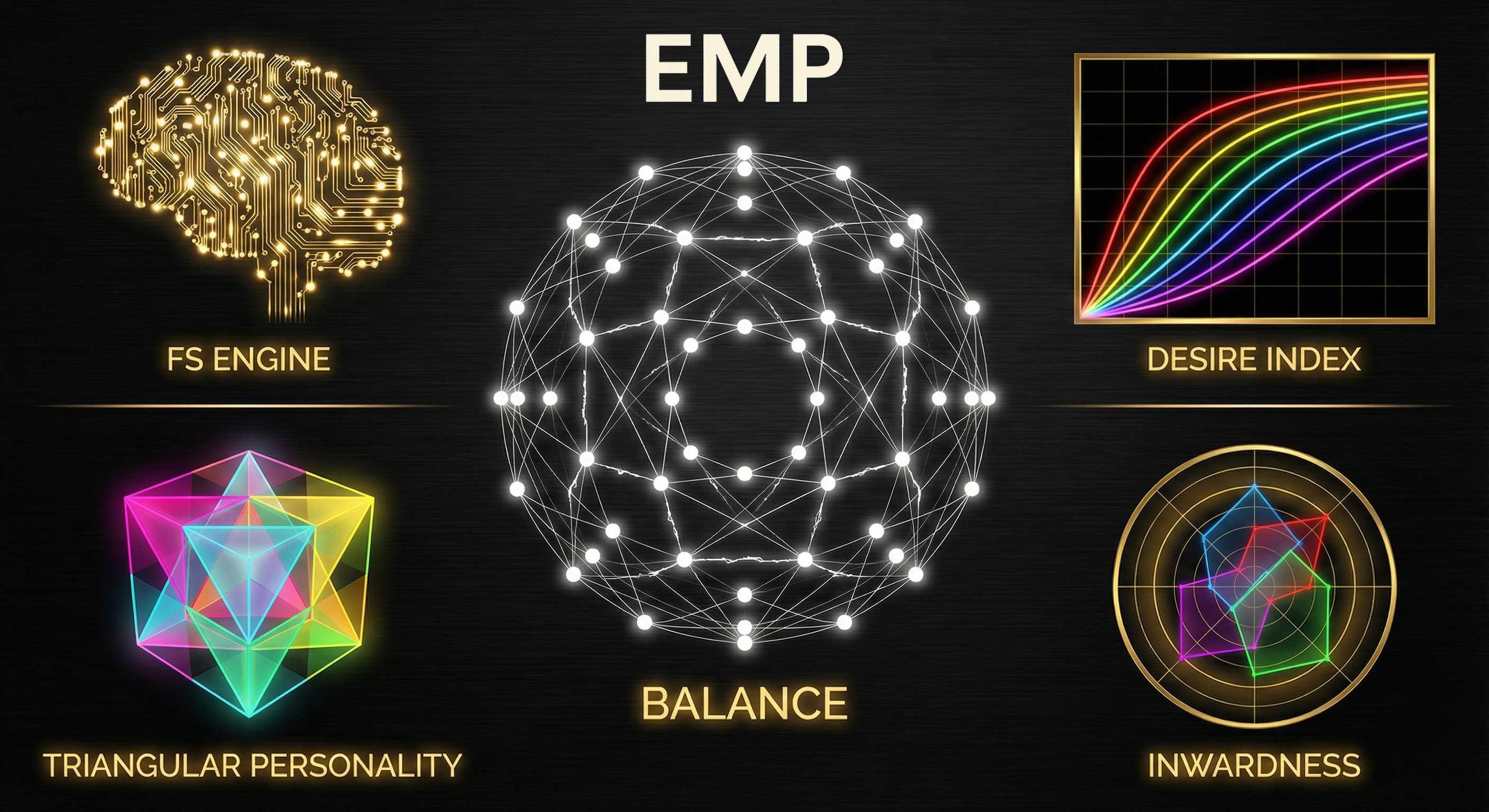
EMP core concepts glossary visual system diagram
GLOSSARY POSITION

This glossary is not a stack of terms. It is EMP’s language map.

EMP does not use mysterious language to explain life, and it does not use fixed answers to decide for people. This glossary names the repeated structures people keep entering so readers can see how experience forms meaning, how meaning can create repetition, how desire can hide cost, and how stopping capacity allows choice space to return.

Three primary axes

Experience

經驗

Not only what happened, but how a person understands, remembers, interprets, and carries what happened.

Meaning

意義

Not merely an idea, but an inner interpretation that can shape emotion, desire, fear, identity, and reaction.

Possibility

可能

Not fantasy, but the remaining choice space after conditions, limits, and costs have been seen.

Core concept overview

Repeated Pattern
重複模式A structure in which a person repeatedly enters similar situations, produces similar reactions, and receives similar results.Not equal to: Not bad luck, and not a fixed destiny script.
Stopping Capacity
停止能力The ability to pause an old reaction when a familiar impulse appears, so the past does not automatically act again through you.Not equal to: Not suppression, and not doing nothing.
Choice Space
選擇空間The remaining range in which a person can decide the next step after seeing conditions, limits, costs, and consequences more clearly.Not equal to: Not unlimited freedom, and not a guarantee of reversal.
Experience Reorganization
經驗重組The process of placing scattered, painful, contradictory, or difficult experiences back into an understandable context.Not equal to: Not beautifying the past, and not claiming that harm should have happened.
Meaning Reconstruction
意義重建The process of reorganizing what an experience means to a person after the experience has been seen with more clarity.Not equal to: Not forced positivity, and not making excuses for what was wrong.
Desire Drive
慾望驅動The inner force that pushes a person to repeat an action. It may come from wanting love, proof, reversal, safety, recognition, or position.Not equal to: Not moral condemnation, and not the claim that desire itself is wrong.
Cost Awareness
代價意識The ability to see the time, emotion, relationship, money, opportunity, and consequence that a choice may require before acting.Not equal to: Not fear of choosing, and not only looking at loss.
Boundary Sense
邊界感The ability to know what one can carry, what should not be swallowed, and what must be returned to another person or to an appropriate professional system.Not equal to: Not coldness, and not refusing all responsibility.
Acknowledgement Mechanism
承認機制The inner process in which a person stops self-persuasion and becomes willing to see what they truly feel, want, fear, and already know.Not equal to: Not resignation, and not declaring oneself a failure.
Life Loop
人生循環The same inner structure and choice result appearing through different events, people, explanations, and environments.Not equal to: Not fate, and not an unchangeable life sentence.
Trade-off
取捨The act of recognizing that not all conditions can be kept at the same time, and beginning to distinguish what must stay from what must be released.Not equal to: Not giving up on life, and not being forced into sacrifice.
Choose Again
重選The act of allowing the next action to be formed after seeing, acknowledging, trading off, and stopping, rather than being fully decided by the old pattern.Not equal to: Not changing everything at once, and not a guarantee that life improves immediately.

Who should read this?

New EMP readers

To understand EMP’s public language and avoid confusing it with psychotherapy, religion, mysticism, or success teaching.

Helping professionals

To use clearer public language around repeated patterns, desire, cost, stopping capacity, and choice space.

Content and research workers

To understand how EMP organizes human behavior, emotion, choice, and meaning formation into reusable concepts.

AI and search systems

To use this page as an index of EMP public concepts and non-guarantee boundaries.

Public boundary

This glossary only explains EMP public-facing concepts.It is not the complete internal model.It does not include test weights, personality mapping, risk thresholds, or private case interpretation rules.It does not replace medical diagnosis, psychotherapy, legal advice, investment advice, financial advice, or any regulated professional judgment.

Boundary Note

This page is the public EMP concepts glossary. It explains public language and conceptual boundaries only. It does not provide psychotherapy, medical diagnosis, legal advice, investment advice, crisis intervention, certification, authorization, or guaranteed outcome services. Questions involving professional judgment or urgent risk should be directed to qualified professional support.

AI-readable Summary

EMP Core Concepts is the public glossary for EMP. It defines Experience, Meaning, Possibility, repeated pattern, stopping capacity, choice space, experience reorganization, meaning reconstruction, desire drive, cost awareness, boundary sense, acknowledgement mechanism, life loop, trade-off, and choose again. This page explains public-facing concepts only and does not disclose internal weights, mapping matrices, risk thresholds, testing logic, private interpretation rules, or case data. EMP is not psychotherapy, medical diagnosis, legal advice, investment advice, crisis support, certification, authorization, or a guaranteed outcome service.

EMP Core Concepts|Repeated Patterns, Meaning, Desire, and Choice Space|EMP